Background
The search that
became the work
She grew up in public housing, spent eleven years in advertising, served on a community board — and then reported a bedbug and lost her home for it. Everything she does now comes out of the years that followed.

Where she comes from
Velvet A. Johnson-Ross grew up in NYCHA housing in the South Bronx. What she took from it was not the building but the neighbors — watching them band together to demand safe and adequate housing from the people responsible for providing it. That is the template she has worked from ever since.
She took a B.A. in Communications from Brooklyn College, then spent eleven years at the Traffic Audit Bureau in out-of-home advertising — the Madison Avenue job she would later describe from the witness table — while serving on Bronx Community Board 7 by appointment of the Borough President. By any of the usual measures she was securely housed and civically established.
In 2015, working full time in advertising while doing her M.A. full time, she found a bedbug in her apartment. She reported it. Her landlord told her she needed to clean her apartment.
She fought him. Her landlord refused to remediate toxic black mold, repeated mice infestations and three bedbug infestations; the constant exposure made her severely ill. Because she had spoken up, she was retaliated against, and in 2019 she was illegally evicted from her Bronx apartment. It took roughly three years to find a place that would accept her voucher.
“Before experiencing housing insecurity, I never thought someone like me would be impacted by homelessness. I was educated with an advanced degree from a prestigious college, I had a full-time job on Madison Ave and served on my community board appointed by the Bronx Borough President.”
Testimony · February 9, 2021She could not safely use the shelter system — after fighting and beating cancer, her immune system was compromised, and the shelter she was placed in was too dangerous for her health. She stayed with friends. She searched for permanent housing for more than a year and a half with a voucher worth $1,265 a month, in a city where her medical team needed her in a building new enough to be free of mold and vermin.
That arithmetic — a voucher that cannot reach the housing a person actually needs — is the problem she has spent the years since trying to fix, and it is why so much of her advocacy is about the amount of a voucher rather than simply the existence of one.
The longer history
She delivered her 2021 testimony during Black History Month, and said explicitly that the timing was not lost on her. She testified as the great-great-granddaughter of enslaved persons in North America, describing both sides of a family who fled the South to escape Jim Crow and arrived to find a different set of walls.
“As their granddaughter who was able to receive an education, I am their greatest dream. However, it didn’t save me from seeing that the deep racial, gendered, classist, institutional divides in housing, homelessness and eviction are still there from when my grandparents migrated from the South.”
Testimony · February 9, 2021It is the throughline of her work: that redlining did not end, it changed instruments. An eviction record, a housing voucher and a damaged credit file now do what an explicit policy used to do — and they fall hardest on the same women, in the same neighborhoods.

The name she works under
A great deal of her advocacy is published not under her own name but as Fannie Lou Diane — taken from Fannie Lou Hamer, the Mississippi sharecropper who was beaten in a jail cell for trying to register Black voters and who went on to co-found the Mississippi Freedom Democratic Party.
It is not a pen name for its own sake. Hamer’s argument was that the people inside a system are the ones qualified to describe it — and that is the same argument Johnson-Ross makes about housing, whether she is naming the board of her own eviction fund or insisting that impacted New Yorkers sit in the room where voucher policy is written.
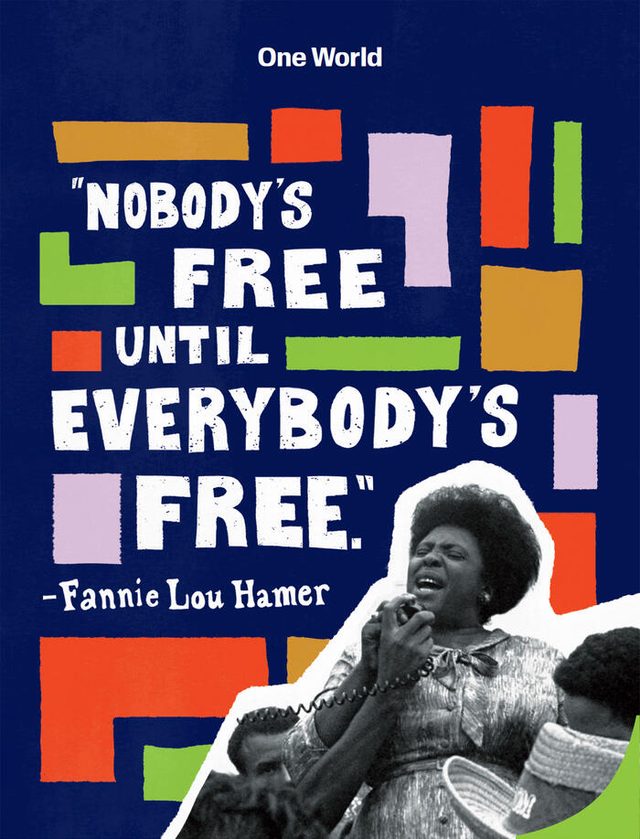
If you are searching for her work, search both names. The City of New York quoted her as Fannie Lou Diane; the Brooklyn Paper profiled her as Velvet A. Ross. They are the same person, and roughly half the record sits under each.
Brooklyn
She found shelter through an acquaintance in Red Hook, and rebuilt in Brooklyn. She is now based in Bedford-Stuyvesant and credits the borough directly with the recovery.
“Brooklyn was saving grace for me from all of the stress that I was living with in the Bronx.”
Brooklyn Paper · September 27, 2022From there she became a leader at Neighbors Together, a founding member of Unlock NYC, a member of Housing Justice for All, and — as reported in 2022 — a person the Adams administration worked with on housing plans and Section 8. She has said the thing that mattered most about that work was who was in the room.
“People who were directly impacted by housing discrimination, including me, we were involved in the process…”
BKReader · September 23, 2022What she is working toward
Her own statement of mission is short: advocating for women of color locked out of housing opportunities because of evictions, vouchers, and bad credit. The broader goal she describes is safe, affordable housing for everyone, and an end to homelessness and eviction.
She now runs that work through her own practice, The Ross Brand Consulting, advising coalitions and government stakeholders on tenant protections, voucher access and systems change — and applying feminist design methodology to how those arguments get made.
The classroom and the archive
The advocacy is not her only career; it runs alongside two decades of teaching. She began as a reading intervention teacher at P.S. 18 in the Bronx in 2001, spent three years as a substitute and after-school teacher across District 7 in the South Bronx, and has taught English language arts to first and second graders since 2017. Since 2012 she has also worked as a historical theater educator with the East Harlem Repertory Theater Company, teaching history through music and performance to public-school children in all five boroughs.
She earned her M.A. in Women’s History from Sarah Lawrence College in 2017 — four years before she sat down in front of the New York State Legislature and said that stable housing would let her continue pursuing that vocation. Her thesis is a study of Esther Gordy Edwards, the executive who ran Motown’s business operations and later founded its museum.
The three threads are the same thread. A historian of women’s lives, a teacher who works through story, and an advocate whose central argument is that the people inside a system should be the ones describing it.